

Air Conditioning
Auto AC Repair in Royal Oak, MI
An air conditioning system is sealed. If it's low on refrigerant, that refrigerant went somewhere, and topping it up without finding out where is how you end up paying twice. We find the leak first.
- Leak found before refrigerant is added
- Full recovery and recharge equipment
- Compressor, condenser and evaporator work
- Limited lifetime warranty on most repairs
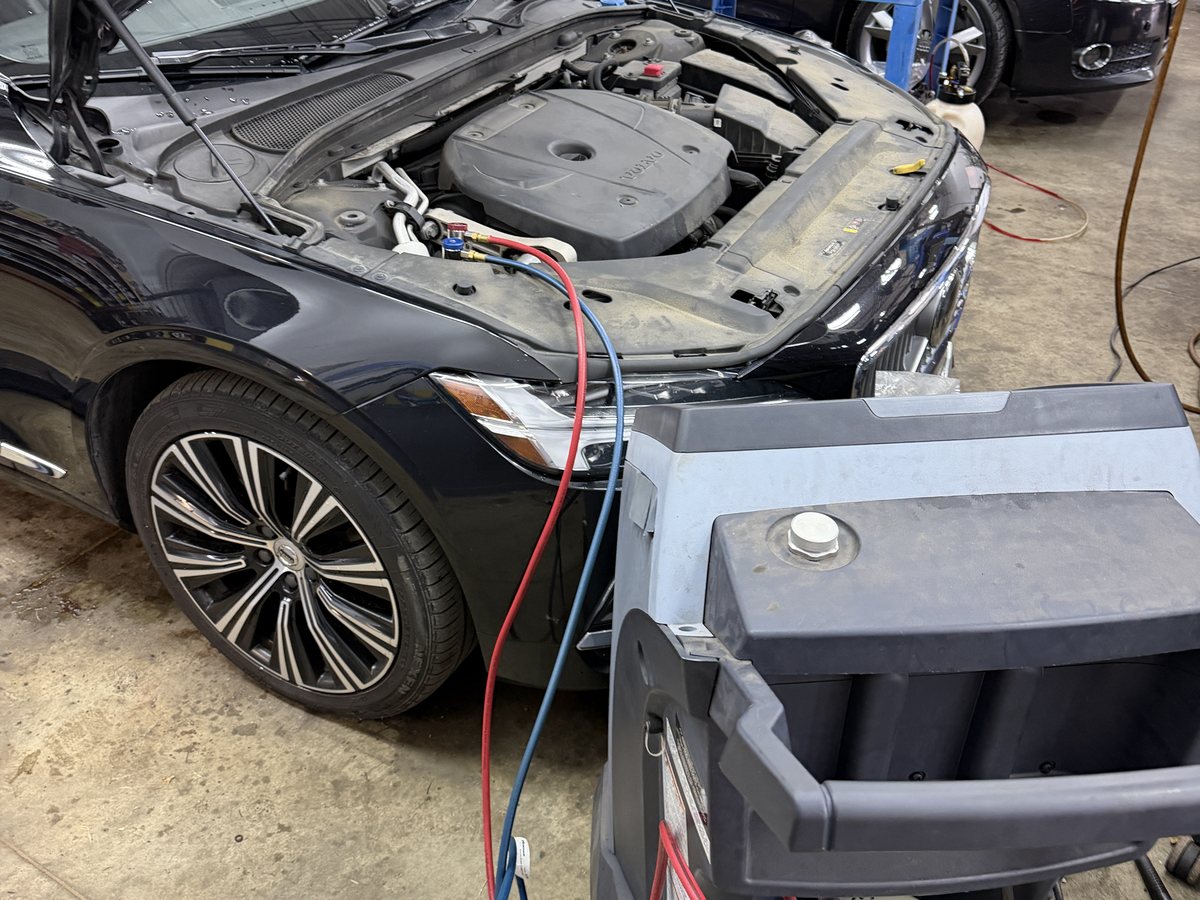
What You Notice First
Six ways an AC system tells you it's losing the fight
Air conditioning rarely stops all at once. It gets worse over a season, which is why so many people only discover it on the first hot day.
It cools, but not like it used to
The most common symptom and the most ignored. A slow refrigerant loss shows up as a gradual drop in performance across a summer, not a sudden failure.
Cold at speed, warm at a stoplight
Airflow across the condenser is doing the work that the system should be doing on its own. That points at a cooling fan, a blocked condenser, or a charge that's already marginal.
The vents smell musty when you switch on
Moisture sitting in the evaporator case, usually because the drain is blocked. It's a health nuisance more than a mechanical one, but it doesn't clear up by itself.
A click every few seconds and no cold air
The compressor clutch cycling rapidly. The system is protecting itself because pressure is out of range, almost always because the charge is low.
A squeal when you press the AC button
The compressor is loading the belt and something is slipping, or the compressor itself is seizing. Keep using it and you can take the belt and everything it drives with it.
Wet carpet on the passenger side
The evaporator drain has backed up into the cabin instead of onto the road. Left alone it gets into the carpet underlay and the smell never really goes.
Two Refrigerants
R-134a and R-1234yf are not interchangeable
Somewhere around the middle of the last decade the industry changed refrigerants, and which one is in your car decides how the job is done. They need separate machines, separate oil and separate fittings, and mixing them contaminates whichever one you put it into.
| R-134a | R-1234yf | |
|---|---|---|
| Roughly which cars | Most vehicles built from the mid-1990s to the mid-2010s | Most vehicles built from about 2015 onward, and almost everything current |
| How to tell | The label under the hood names it, and the service ports are the larger of the two sizes | Named on the same label, with smaller quick-connect ports that will not accept a 134a hose |
| Oil in the system | PAG oil, viscosity set by the compressor | PAG oil to a different specification, and it is not the same bottle |
| What a recovery machine does | Recovers, vacuums and recharges by weight | The same, plus a refrigerant identifier, because contaminated systems are common enough to check for |
| Cost of getting it wrong | A system charged with the wrong refrigerant has to be recovered, flushed and started again | Same, and a contaminated machine takes the next customer's car with it |
This is the reason we do not top a system up and send you away. Refrigerant does not get used, so a system that is low has a leak, and the useful work is finding it. Everything comes out, goes across a scale, and goes back in by weight.
Worth knowing
Air conditioning does not use refrigerant up
It is a sealed loop, so the same charge should still be in there years later. A system that is low has a leak somewhere, and topping it up without finding that leak buys you one more summer at most. Refrigerant leaving the system is also taking oil with it, which is what eventually kills the compressor.
How We Work It
From warm vents to a fixed system
Every step exists to avoid selling you refrigerant twice.
-
Performance test before anything is opened
Vent temperature, pressures on both sides, compressor engagement and fan operation, with the readings written down as a baseline.
-
Recover and measure what's in there
The existing charge comes out into the machine and gets weighed. How far off the specification it's tells us how fast the leak is.
-
Find the leak
Vacuum hold test, dye, and an electronic detector. We don't move on until we can point at the actual failure.
-
Repair the failed part
Compressor, condenser, evaporator, hose, or a seal. Whatever failed gets replaced, along with the receiver dryer when the system has been opened to atmosphere.
-
Evacuate, recharge by weight, retest
Deep vacuum to pull out moisture, then the exact charge from the label. Then the same performance test as step one, to prove the numbers moved.
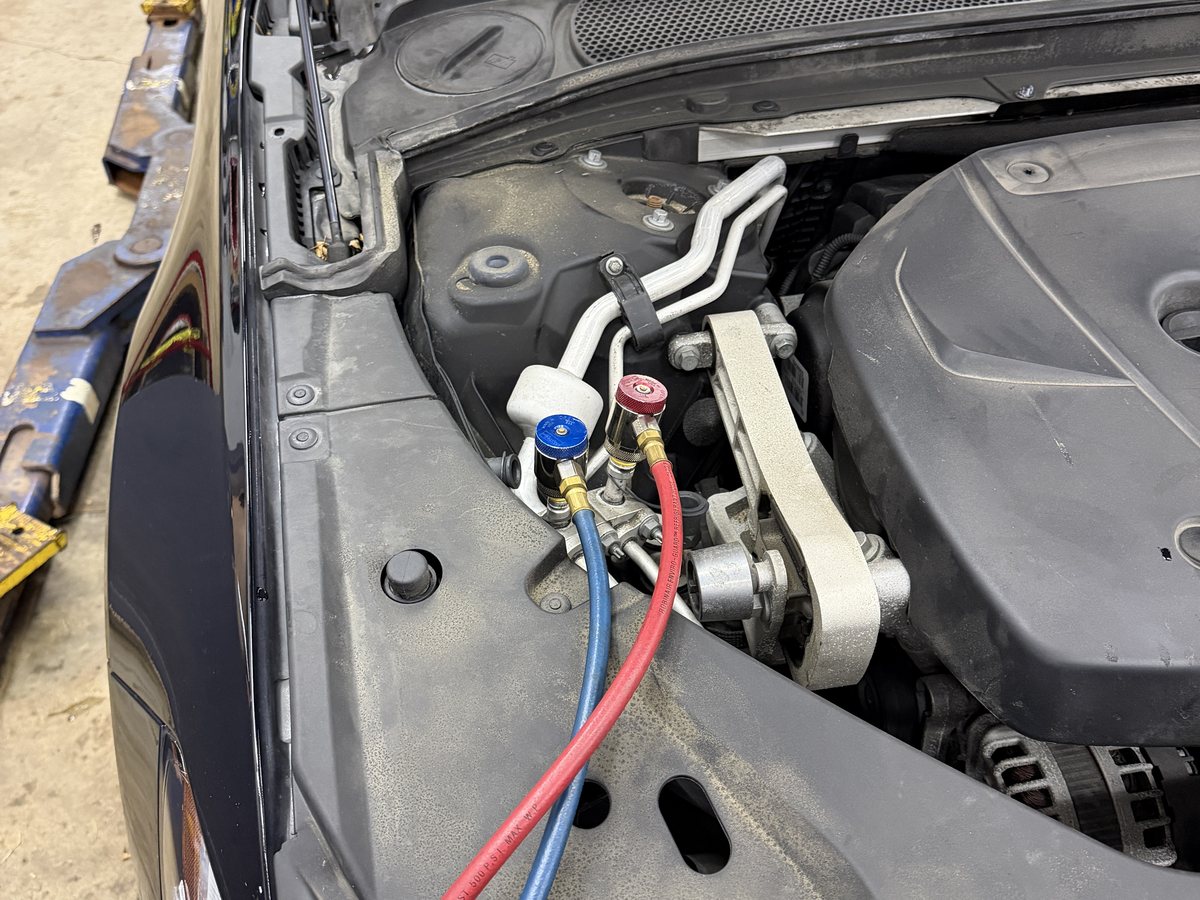
Why We Do Not Just Top It Up
A recharge is a diagnosis, not a repair
Air conditioning is a closed loop. Refrigerant isn't consumed the way fuel or oil is, so a system that's low has a leak, full stop. Adding gas to a leaking system buys you a few weeks and tells you nothing about where it went.
So we put the system under vacuum and watch whether it holds, and we use dye and an electronic detector to find the actual leak point. Condenser stone damage at the front of the car, a tired compressor shaft seal, a hardened O-ring at a line fitting, a corroded evaporator behind the dash. Each of those is a different repair and a different price.
Only then does refrigerant go back in, by weight, to the figure on the under-hood label. Charging by gauge pressure alone is guesswork, and an overcharged system cools worse than a correctly charged one while putting the compressor under load it was never designed for.
Not every warm vent is an AC fault. A blower that works but blows hot when the engine is also running warm points at the cooling system, which is engine work, and a climate control module throwing codes starts with a diagnostic test rather than a refrigerant charge. If you are buying a used car in summer, the AC check is part of our pre-purchase inspection.
Questions
Air conditioning questions
Can you just recharge it?
Why is my AC cold on the highway and warm in traffic?
How much does AC repair cost?
Does my car use the newer refrigerant?
Why does my AC smell bad?
Should I run the AC in winter?
Is the repair covered by warranty?
What You Get
Every AC service includes
- Vent temperature and system pressure readings
- Compressor and clutch operation check
- Condenser and cooling fan inspection
- Vacuum hold test for leaks
- Dye or electronic leak detection where needed
- Charge by weight to the manufacturer figure
- Cabin air filter check
- A post-repair performance test you can see
Related Work
Related systems
Book It
Blowing warm? Book it before the next hot week
We find the leak before we sell you refrigerant. 29444 Woodward Ave, Royal Oak. Book online or call and we'll get it on a lift.