
A squeal that comes and goes
Most pads carry a small metal tab that starts singing when friction material gets low. It's doing its job. Caught at the squeal it's usually a pad set; ignored until it grinds it becomes pads and rotors.
Mon - Thu 8:00 AM - 5:30 PM
Fri 8:00 AM - 5:00 PM

Brake Service
Pads, rotors, calipers, hoses and fluid, on every make and model. We pull the wheels and measure before we quote, so you're paying for the brake work your car actually needs and not for a menu price.
When To Come In
Brakes almost never quit without warning. They tell you first, usually for weeks. Here's what each signal actually means underneath, in the order we tend to see them.
Most pads carry a small metal tab that starts singing when friction material gets low. It's doing its job. Caught at the squeal it's usually a pad set; ignored until it grinds it becomes pads and rotors.
That's steel backing plate against rotor face. The friction material is gone. At this point the rotor is a measurement rather than a clean-up, and a caliper can be damaged too if it went on for long.
Rarely the pads. Usually brake fluid that has absorbed water and boiled, or a flexible hose that balloons under pressure instead of transmitting it. New pads won't fix a pedal that sinks.
One corner is doing more work than the other, normally a sticking caliper slide pin or a collapsed hose holding a pad against the rotor. An alignment won't cure a dragging corner.
Thickness variation across the rotor face from repeated heat cycles, which is the everyday result of stop-and-go traffic on Woodward. It isn't a tire balance problem. We measure runout at the hub before selling rotors.
A caliper that isn't releasing. The pad is cooking against the rotor and the heat has nowhere to go. If the wheel is too hot to touch, stop driving it and call us rather than driving it in.
Reading The Measurement
Brakes are one of the few things on a car that can be measured rather than judged. Every pad we look at gets a number in millimeters, and this is what those numbers mean, so a report from us is something you can read yourself.
This is roughly where a pad starts life. Some performance pads start thicker and some small cars thinner, so the figure that matters is how far it has come down, not the number on its own.
Nothing to do. If you are seeing this on a report with a recommendation attached, ask what the recommendation is for.
This is where we tell you it is coming rather than that it is due. On most cars that is another few thousand miles, and it means you get to choose when rather than finding out on a Friday afternoon.
Below this the friction material is thin enough that it heats up faster, fades sooner and stops shedding heat into the pad backing the way it was designed to. This is the point at which we say it needs doing.
The wear indicator is either squealing or about to. What follows is the backing plate on the rotor, and a pad set becomes a pad and rotor set.
Grooves cut into the rotor face, and usually the caliper has been running at the end of its piston travel long enough to be worth checking too. This is the expensive version of a job that was cheap two months ago.
Rotors carry their own number. Every rotor has a minimum thickness cast or stamped into the hat, and once it is machined below that figure it is scrap rather than a judgement call. We measure them rather than guess, which is why some rotors get resurfaced here and some do not.
What Actually Wears
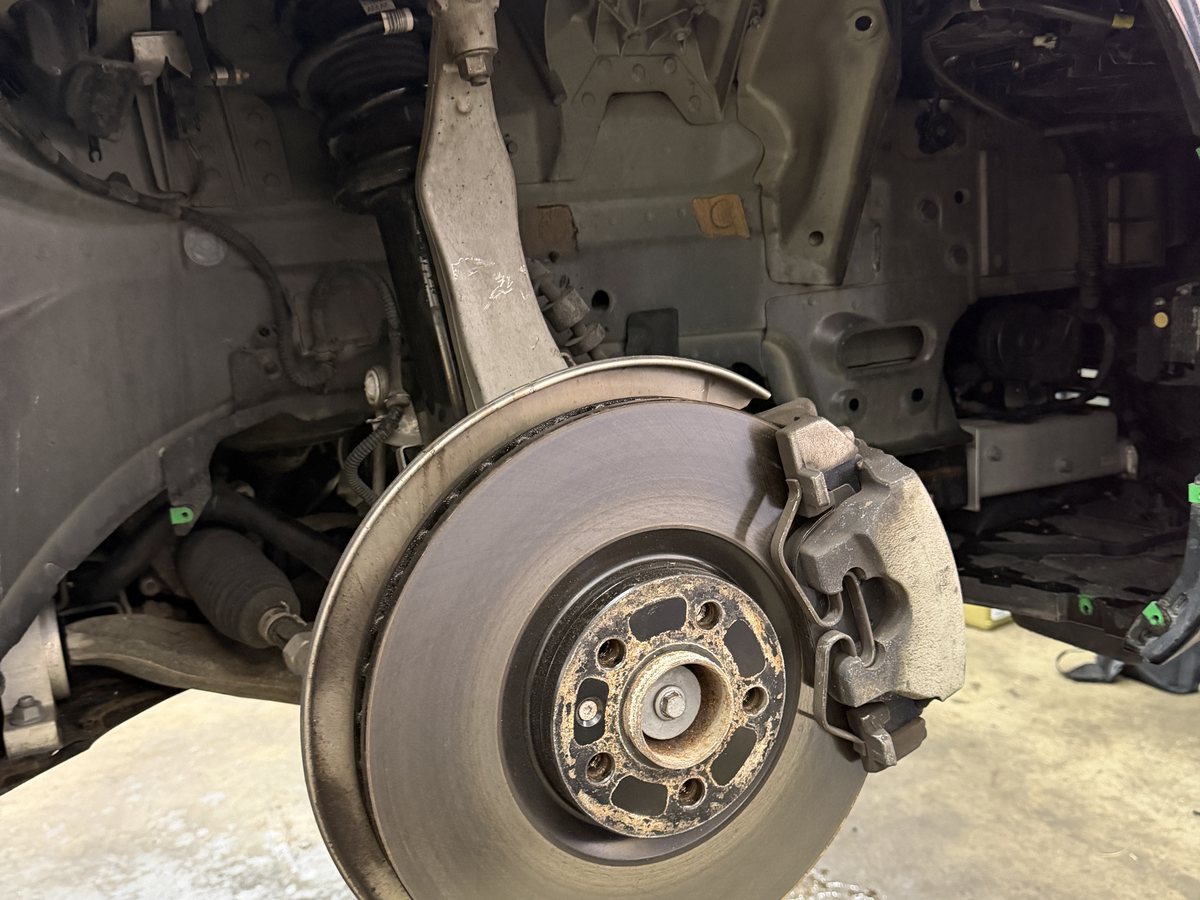
A pad is designed to be consumed. A rotor is designed to survive several sets of pads, and the factory casts it with a minimum safe thickness stamped into the hat. Those two facts are why a proper brake quote has to start with a caliper measurement rather than a price list.
We measure remaining pad material, rotor thickness against that stamped minimum, and runout at the hub. Then we tell you which of the three you're actually buying. Sometimes it's pads only. Sometimes the rotor is under spec and has to be replaced whatever the pads look like.
Fluid gets its own answer. Brake fluid is hygroscopic, meaning it pulls moisture out of the air over time, and water boils far below the temperature a hard stop puts through a caliper. That's what a fading pedal on a hot day usually is. We test it rather than bundling a flush onto every ticket.
Brake complaints overlap with two other systems. A shake you feel in the steering wheel under braking is usually rotors, but a shake at highway speed with your foot off the pedal is tire balance, and a pull that is there whether you are braking or not is alignment or a worn suspension part. We sort out which one it is on the lift before quoting anything.
Worth knowing
It is hygroscopic, and it takes moisture in through the reservoir cap and the rubber hoses whether the car is driven or not. Water lowers the boiling point, and fluid that boils gives you a pedal that goes to the floor on a long downhill. That is why fluid is replaced on time rather than when it looks dirty.
How The Job Runs
No part of this is a surprise. You get the measurements and the number before anything is ordered.
Pad depth, rotor thickness and runout, hose condition, slide pin movement and parking brake function, all written down. The inspection is free and it happens before any quote.
We tell you what each measurement is and which parts that makes necessary. If something can safely wait a few thousand miles, we say so rather than selling it today.
Pads, clips, shims and rotors that suit the vehicle and how it gets driven. Slide pins are cleaned and greased rather than reassembled dry, which is what causes the next sticking caliper.
If the fluid has taken on moisture we exchange and bleed it. If it's healthy we leave it alone and tell you when to look at it again.
Pedal feel, straight-line stop, no pull and no warning lamps, confirmed on real roads rather than across the parking lot.
What You Get
Questions
Related Work
In Their Words
★★★★★
This shop excels at service. From the simple oil change or brake repairs to the more complex engine maintenance, they don’t just make sure to complete the prescribed tasks with high quality, they also educate you on the overall health of your car going forward. They’re not pushy and they don’t have egos. I feel good about working with this team and I have come to trust them with making sure my car continues to be an enjoyment, rather than a hassle. I drive a Mercedes and I’m sure it’s not an easy thing to be able to handle European specs.
★★★★★
I forget the gentleman’s name I worked with at the counter. But he was awesome! Very polite, greeted me, offered snacks and other refreshments. He even switched out my tires for free! I worked the night shift so I napped most of the appointment, but I will definitely come back. I got an oil change, front brakes done. The price was a bit pricey, but I think this may be the norm for car services around royal oak, and the service I received was much worth it. Being a woman, it’s important to feel comfortable and not feel taken advantage of.
★★★★★
Amazing and generous people, I replaced my brakes and caliper, everything was fine but when i was driving to work i heard metal starting to clink around. Pulled over and the bottom bolt connecting my caliper to the knuckle was half way out. I hand tightened and drove it to them. Within 15 minutes they had my car completely tightened and good to go at no charge. Amazing service, very nice and generous employees. I highly recommend them for all your car repair needs.
Book It
Free inspection, real numbers, and a price before anything is ordered. Book online or call the shop at 29444 Woodward Ave. Shuttle service and after-hours drop-off available.