

Muffler & Exhaust
Muffler Shop & Exhaust System Repair in Royal Oak, MI
Exhaust is the system Michigan salt destroys first. Most of what we see doesn't need a whole new system, it needs the failed section replaced and the rest inspected properly so you aren't back in three months.
- Section repairs where the rest is sound
- Welding and fabrication in house
- Leak and hanger inspection
- All makes and models
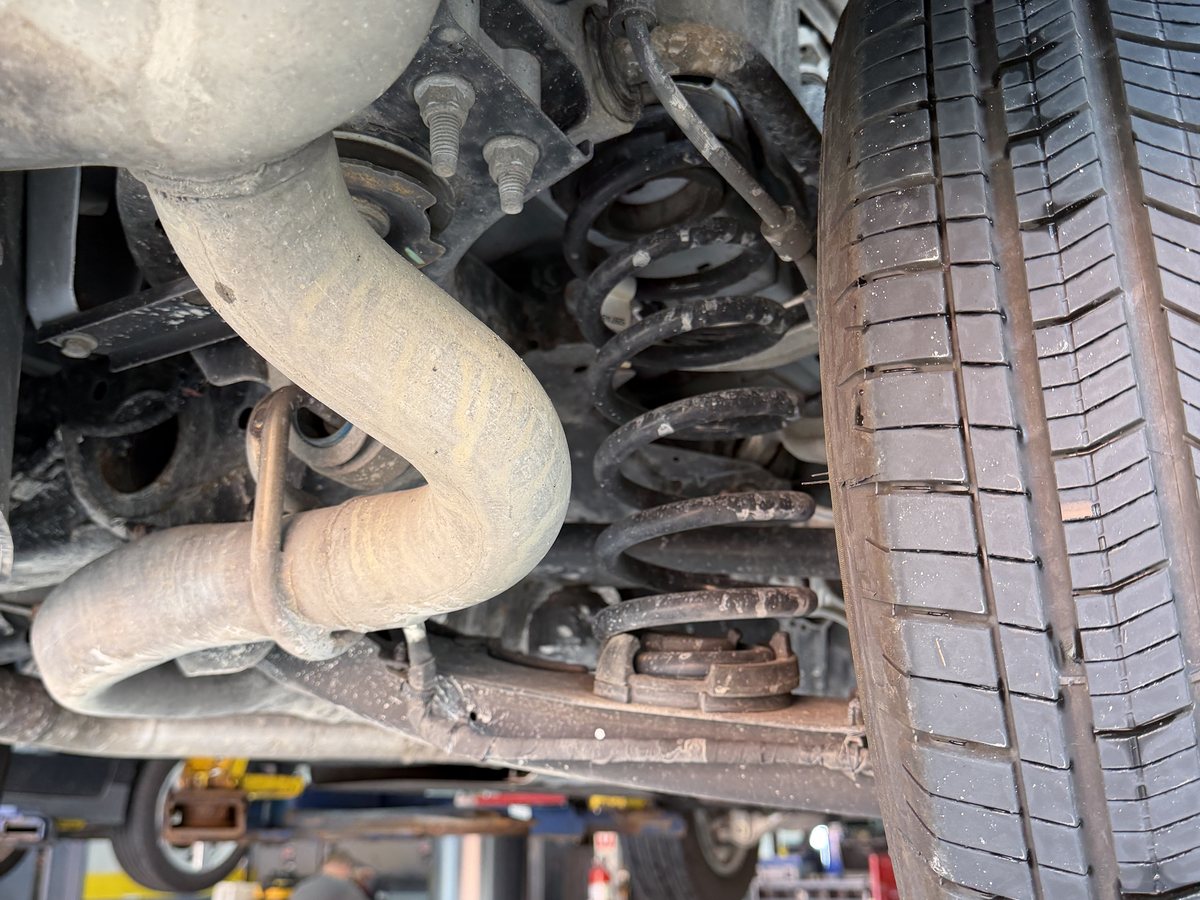
What You Hear And Smell
Six ways an exhaust leak announces itself
An exhaust problem is rarely subtle. The question is usually which section, and whether the rest of the system is worth saving.
It suddenly got loud
A hole, a split seam or a rotted muffler. The volume tells you there's a leak; where it's loudest under the car tells us roughly which section.
A ticking that rises with engine speed
Classic exhaust manifold gasket leak. It ticks because a small high-pressure pulse is escaping on every exhaust stroke, and it's usually loudest on a cold start.
A rattle or scrape underneath over bumps
A broken hanger letting the system swing, or a heat shield that has rusted loose. Both are cheap now and expensive if the system drops and gets dragged.
You can smell exhaust inside the car
Stop driving it and get it looked at. A leak forward of the cabin can put carbon monoxide inside, and that's a genuine safety issue rather than a noise complaint.
The check engine light came on with the noise
Exhaust leaks upstream of an oxygen sensor let extra air in and skew the reading, which makes the engine run badly and sets codes that look like fuelling faults.
It fails an emissions check
Often a converter that has been killed by something else, typically a long-running misfire. Replacing the converter without fixing what killed it just buys another one.
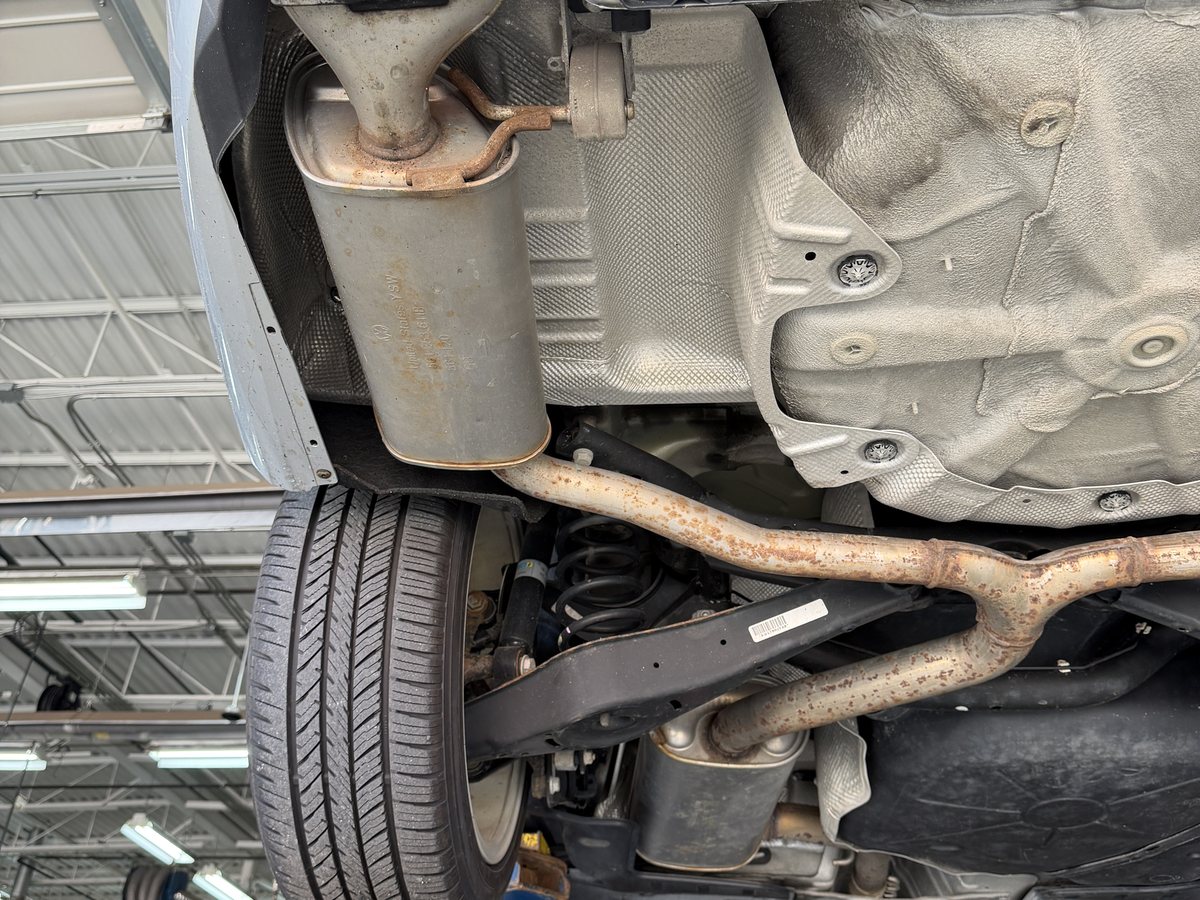
Section Versus System
You usually don't need the whole exhaust
A modern exhaust runs from the manifold through the catalytic converter, a resonator, the muffler and the tailpipe, with sensors and hangers along the way. Those parts don't all fail at once, and they don't all fail at the same rate.
Salt does the damage from the outside in, which is why the sections that sit lowest and hold moisture rot first. Very often the converter and the front pipe are structurally fine while the rear section is finished. Quoting a whole system in that situation is easier for a shop and more expensive for you.
So we put it on a lift, find the actual failure, and check the condition of what's left before recommending anything. Where a section can be cut out and a new one welded in, we'll do that. Where the rest of the system is so far gone that a section repair won't last, we'll tell you that plainly rather than selling you a repair we expect to see back.
Exhaust noise is the easy part to diagnose. The harder calls are the ones that look like exhaust and are not: a rattle over bumps can be a heat shield or a worn suspension link, a check engine light with a catalyst code may trace back to a fuel mixture problem that will ruin a new converter, and a sulfur smell with poor power needs a diagnostic test before any parts. Diesel exhaust, with its DPF and DEF system, is handled on the diesel page.
Where It Rots
Exhaust fails in the same places, in the same order
An exhaust system does not wear out evenly. It rots from the inside out, at the low points, and a Michigan winter accelerates every part of that. This is the running order we see, front to back.
-
First
The flex pipe
The braided joint behind the manifold takes every bit of engine movement and heat cycling on the system. It usually separates rather than rusting through, and the noise arrives suddenly: a loud rasp that is worst on a cold start and quiets as things expand.
-
Second
Seams and pipe joints
Anywhere two pieces are clamped or welded, condensate collects and salt sits. A joint leak is a ticking or puffing sound that changes with engine speed and often disappears once everything is hot and has expanded shut.
-
Third
The bottom of the muffler
Every short trip puts water in the exhaust that never gets hot enough to steam out. It pools in the lowest point of the muffler shell and rusts it from the inside, which is why the hole is almost always underneath where nobody looks.
-
Fourth
Hangers and mounts
Rubber isolators perish and the steel hooks they hang from corrode. A dragging or knocking sound over bumps is usually this, and a hanger is a small repair that stops a much larger one, because an unsupported system tears itself apart at the joints.
-
Last
The catalytic converter
Converters normally fail because of something else: an engine running rich, an oil burner, or a misfire dumping fuel into it. Replacing one without finding that cause means doing it twice, which is why a converter code gets a diagnosis before it gets a quote.
If your exhaust has started making noise, the useful question is where along the car it is coming from. That one answer usually decides whether this is a small repair or a section replacement, and it is free to ask over the phone.
Worth knowing
The hole is almost always underneath
Every cold start puts water in the exhaust, and on a short trip it never gets hot enough to steam out. It pools in the lowest point of the muffler and rusts the shell from the inside. Which is why short winter trips are harder on an exhaust than highway miles, and why nobody spots the hole by looking.
How It Runs
Finding and fixing an exhaust fault
The diagnosis is fast. The judgement about how much to replace is where the money is.
-
Listen with it running, on the ground and on a lift
Where a leak is loudest narrows the section before anything is touched.
-
Inspect the full length
Manifold to tailpipe, including hangers, heat shields, sensor bungs and the condition of the converter shell.
-
Decide section or system, honestly
If the rest has life in it we repair the section. If it doesn't, we say so and show you why on the car.
-
Weld or replace
Clamped joints where they belong and welded joints where they last longer. Hangers replaced rather than reused if they're corroded.
-
Run it and re-check for leaks
With the engine running and the system hot, because some leaks only open up once everything has expanded.
Questions
Exhaust questions
Do I need a whole new exhaust system?
Can you weld my exhaust instead of replacing it?
Why did my check engine light come on with an exhaust leak?
Is a loud exhaust actually dangerous?
How much does a muffler cost?
Why do exhausts rust out so fast here?
Do you do catalytic converters?
What You Get
Exhaust work includes
- Full length inspection on a lift
- Leak location before any quote
- Hanger and heat shield check
- Section repair where it's the right call
- In-house welding
- Oxygen sensor condition noted
- Post-repair hot leak check
- Honest advice on converter replacement
Related Work
What an exhaust fault drags in
In Their Words
What customers say about exhaust work
★★★★★
I live in Northwood area and I brought two of my cars to First Call to get oil changes as well as one of them to fix an exhaust leak. Everything was fixed in a timely manner. Scott was very friendly and professional. The software they use to get your approval to preform work is very user friendly. First Call is also reasonably priced. I will be using First Call moving forward to maintain all my vehicles!
★★★★★
I brought my 2021 Traverse in for a loud exhaust. I worked with Scott on getting the vehicle inspected and diagnosed. I had a digital summary and estimate of what the issue was including pictures and what it would cost to fix within a couple hours. I told him I needed it back by the end of the day. He said it would be tight as he wasn’t sure when the parts would be delivered. Scott kept me updated throughout the day and my vehicle was completed that day. I will definitely use First Call in the future.
Book It
Gone loud? Get it looked at before it drops
We'll find the section that failed and tell you honestly how much needs replacing. 29444 Woodward Ave, Royal Oak. Book online or call.