

A coil spring holds up the corner of your car. When one cracks or snaps, that corner loses support, and the car tells you in a few different ways: a clunk over bumps, a visible lean, a tire that rubs, a ride that suddenly feels loose. If you searched for broken spring repair in Royal Oak because something changed in how your car sits or sounds, this page covers the symptoms, why springs break so often in Michigan, what it does to your tires and alignment, and the real choices you have when it is time to fix it.
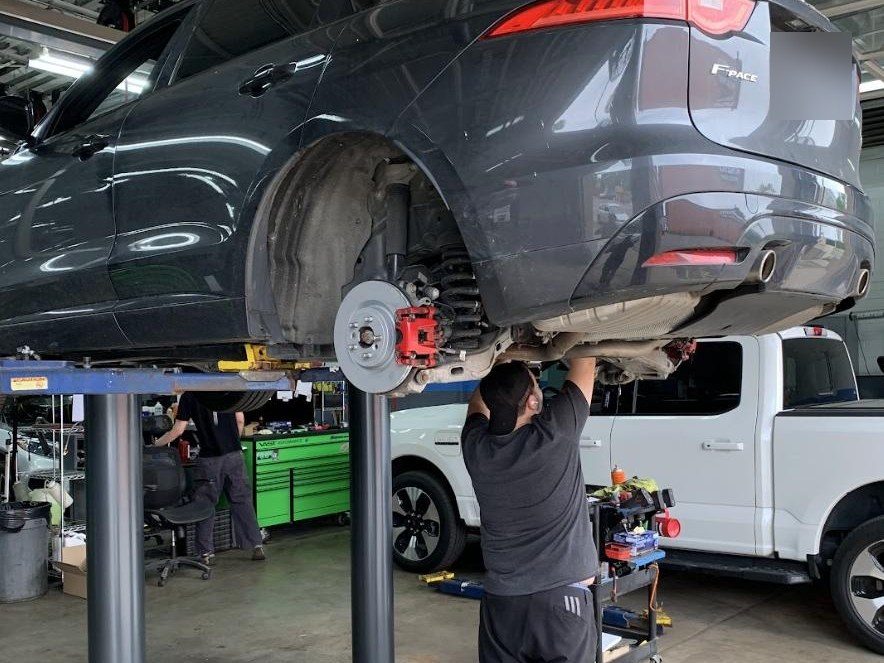
What a coil spring does
The spring carries the weight of the vehicle and lets the wheel move up and down over the road. The shock or strut does not hold the car up. It only controls how fast the spring moves. That is why a broken spring changes ride height right away, while a worn shock usually just makes the car bouncy. On many cars the spring sits around the front strut. On many others, especially at the rear, it is a separate part that sits beside or near the shock.
Symptoms of a broken coil spring
- A clunk, rattle or bang over bumps. A broken end can shift and hit the mount, the strut or the body. You may also hear a scrape or a metallic twang when turning into a driveway.
- One corner sitting lower. A spring that has snapped or collapsed no longer holds its share of the weight. Parked on level ground, the car looks tilted, or one wheel gap looks smaller than the others.
- Uneven ride height. Compare the gap between tire and fender on both sides of the same axle. A visible difference is a strong clue.
- A tire rubbing the fender or liner. A low corner can let the tire contact the body on bumps or turns.
- Handling that feels loose or leans harder in one direction. The car may feel unsettled in corners or drift on the highway.
- Uneven or fast tire wear. A corner that sits low changes how the tire meets the road. Look for one edge wearing faster than the rest.
Not every clunk is a spring. Worn sway bar links, control arm bushings, strut mounts and ball joints make similar noises, and a technician tells them apart by inspection, which is part of suspension repair in Royal Oak. A spring is the cause when the car also sits visibly low, or when the spring itself shows a crack or a missing section.
Why springs break in Michigan
A coil spring is a steel bar wound into a coil, and it flexes thousands of times every trip. Steel springs are coated to keep moisture off, and Michigan works hard to defeat that coating.
- Road salt. Salt brine thrown up from the road chips and eats the coating, then attacks the bare steel. Rust pits form on the surface of the wire.
- Freeze and thaw. Water gets into small chips and pits, freezes, and widens them. The cycle repeats all winter.
- Potholes. A hard hit sends a sharp load through a spring that may already be weakened. Small cracks that started at a rust pit can open up.
- Fatigue. Metal that flexes constantly will eventually crack at its weakest point. A rust pit is a weak point, so corrosion and flexing work together.
That combination is why springs often fail in late winter and spring, after a season of salt and potholes, even though the damage built up over many months. Age and mileage also matter, but a rust-free spring in a dry climate can last far longer than one that has spent years in salt. We cannot give you a mileage at which a spring will break, and anyone who gives you one is guessing.
How a broken spring affects alignment, tires and handling
Alignment. Ride height and wheel angles are linked. When a corner sags, the camber and toe change, and the car may pull or wander. That is why a sagging corner is one of the causes we check when a car does not drive straight, and why replacing a spring is normally followed by an alignment check. Our wheel alignment page explains what is measured.
Tires. A tire that leans because of a low corner wears on one edge. If you have been driving on a broken spring for a while, the tire may be damaged even after the spring is fixed. A technician can check tread depth across the tire, and our tire shop page covers rotation, balance and replacement.
Handling. Less spring support means more body roll, more nose dive under braking, and less predictable steering. A broken piece can also move around inside the wheel well and, in rare cases, damage a tire or other component. That is a reason not to treat a visibly low corner as something that can wait for months.
How to check for a broken spring yourself
You can look, but do not get under a car supported only by a jack, and do not try to remove a spring yourself. A coil spring under load stores a lot of energy and can cause serious injury if released.
- Park on level ground with the wheels straight, and step back to look at the car from the front and rear.
- Compare the gap between the top of each tire and the fender, left against right on the same axle.
- Press down firmly on each corner of the car and release it. A corner that feels much softer or settles differently than the others deserves a closer look.
- With a flashlight, look behind the wheel at the spring for a gap, a piece that has moved, or heavy rust flaking from the coils.
- Look at your tires for one edge that is wearing faster than the other.
- If you find any of these, call us instead of driving farther than you need to.
None of this replaces having a technician look underneath on a lift, which is the only way to see the top and bottom spring seats properly.
Replace in pairs or just one?
Most shops recommend replacing springs in pairs on the same axle, and there is a real reason. A new spring is taller and stiffer than the old one beside it, and an old spring that is still intact has lost some of its original height. The result can be an uneven stance and different handling from side to side. Springs on the other end of the car are usually not part of the pair.
The trade-off is cost and judgment. Doing a pair costs more in parts and may add labor, but it keeps the axle matched. Replacing one can be reasonable when the other spring is relatively new, rust-free and the right type, but it is a judgment call, and it should be made by someone who has looked at both springs. Ask the technician what the other spring looks like and what they recommend. If a spring has broken from corrosion, the one on the other side has lived through the same salt, and that is a good argument for the pair.
OE or aftermarket springs
OE (original equipment) springs are made to the specification the vehicle was built with, so ride height and spring rate match what the manufacturer intended. Aftermarket springs range from good quality to poor. Some are made to the original specification, some are heavy duty, and some change ride height on purpose, which matters because a taller or lower stance affects alignment angles and tire clearance.
- The right spring for your vehicle. The same model can use different springs depending on engine, options, trim or towing equipment. Make sure the part matches your car, not just the model name.
- Price versus fit. Aftermarket parts can cost less, but cost is only worth saving if ride height and quality match. Ask what is being quoted and who makes it.
- Intended use. If the vehicle carries loads or tows, tell the technician before the parts are chosen.
Spring only or complete strut assembly
On a vehicle where the spring wraps around the strut, you usually have two ways to repair a broken one. The spring is held in compression to take it apart, which takes a spring compressor and care. On a rear spring that sits separately from the shock, the choice often does not come up.
| Option | What is replaced | Upside | Trade-off | Often makes sense when |
|---|---|---|---|---|
| Spring only | The spring (and often the seat or isolator) | Lower parts cost; keeps the existing strut | The strut is taken apart, and any worn strut or mount stays on the car | The strut and mount are in good condition |
| Complete strut assembly | Strut, spring, mount and related parts as one unit | Fresh strut and mount in the same job; less disassembly | Higher parts cost; not every vehicle has a complete unit available | The strut is leaking or worn, or the mounts are tired |
| Spring on a separate-mount rear | The spring and its isolators | Simple job on many vehicles | Rust can seize hardware and extend the work | A separate spring has cracked or collapsed |
If the strut is already leaking or worn, putting a new spring on it just means paying for another visit later. If the strut is fine, a spring alone may be enough. A technician can check which is true when the spring is out.
How long does it take, and is this the expensive version?
There is no honest single number for either answer. Time depends on the vehicle, whether it is front or rear, whether you are doing one side or a pair, and how corroded the bolts are. Seized or rusted fasteners are common in Michigan and can add work. An alignment check afterward adds time. Parts availability can matter too, especially for older or less common vehicles. Ask for an estimate for your car and for what could change it.
For cost, the main drivers are the same ones: one spring or a pair, spring only or complete assembly, OE or aftermarket, and whether anything else is worn. A pair of springs is not the same job as a complete strut replacement, and a quote should tell you which one you are getting.
First Call Auto Care technicians are ASE and State Certified, and our parts and workmanship are covered by our Lifetime Limited Warranty. Ask us how it applies to your repair.
Frequently asked questions
Why does a coil spring break instead of just wearing out?
A spring is a bar of steel twisted into a coil, and every bump twists it a little. Under repeated stress a tiny crack can form, usually where rust has pitted the surface, and then grows with each flex until the coil fails. Because the crack grows from one point, a spring often breaks suddenly rather than softening slowly.
Why do some springs sag without ever breaking?
Steel that is squeezed and released over and over can slowly take a "set," meaning it settles a little shorter than it started and no longer pushes back with its original force. The car then sits lower on that corner even though nothing has cracked. It looks like a break from the outside, which is why a technician compares the spring against the other side before deciding.
Why does spring rate matter when choosing a replacement?
Spring rate is how much force the spring needs to compress a given distance. A stiffer spring holds the body up with less travel and a softer one lets it move further. If the rate is wrong for the vehicle, ride height, body roll and how the shock or strut is loaded all change, so the replacement should be matched to your car rather than just its model name.
Will new springs fix my tire wear?
They will stop the cause if the low corner was changing how the tire met the road, but they will not undo wear that has already happened. After the repair, an alignment check confirms the angles are within specification, and a tire inspection shows whether the worn tire is still serviceable.
Why does a broken spring make a clunk?
With the coil intact, the spring keeps the suspension off its travel stops and keeps its seats loaded. When it breaks, the broken ends can move on their seats, and the suspension can drop further than designed and hit its stop or the body. That metal or rubber-on-metal contact is the sound you hear, and it is loudest over bumps because that is when the wheel travels most.
Call us about a low or noisy corner
If your car sits low on one side, clunks over bumps or has a tire wearing on one edge, give us a call. We will look at the spring, the strut and the parts around them, and explain what we find and what your options are.